English
- English
- 中文
What is the difference between a wound cell and a laminated cell? Why don't mobile phone batteries use lamination technology?
Time: 2024-12-03 10:15:13
Author: Shenzhen GXHS Electronic Technology Co., Ltd.
Click:
At present, mobile phone batteries mainly use the winding process. The winding process is an energy storage monomer that combines the positive electrode, separator, and negative electrode in a winding way, which is called a winding battery. A single wound battery is also known as a cell, and the battery industry insiders call it a coil core.
At present, mobile phone batteries mainly use the winding process. The winding process is an energy storage monomer that combines the positive electrode, separator, and negative electrode in a winding way, which is called a winding battery. A single wound battery is also known as a cell, and the battery industry insiders call it a coil core.
What is the difference between the winding process and the lamination process?
The battery manufacturing process is mainly divided into two technical routes: lamination process and winding process.
There are significant differences between the winding process and the lamination process in battery manufacturing, which are mainly reflected in the process principle, electrical properties, mechanical stress, energy density design, etc
Process principle
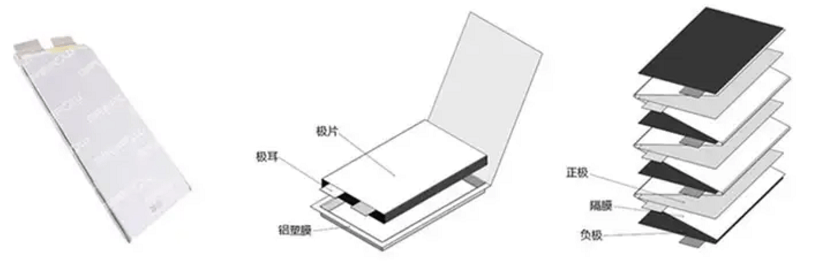
Lamination process: The positive and negative electrode pieces are cut to the required size, and then superimposed with the separator to form a small cell cell, and then the small cell cells are stacked and connected in parallel to form a battery module. The cutting of pole pieces in this process mainly adopts two methods: die punching and laser cutting
Winding process: The positive electrode piece, diaphragm and negative electrode piece are wound according to a certain order by fixing the needle, and extruded into a cylindrical or square shape. The size of the pole piece and the number of turns to be wound are determined by the design capacity of the battery.
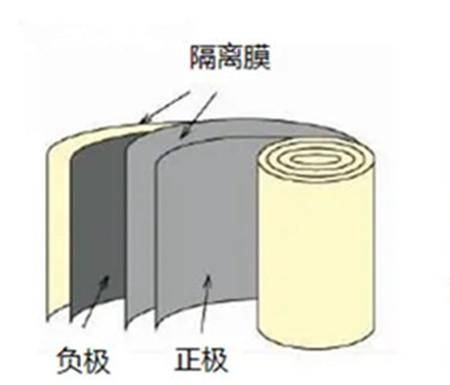
Comparison of advantages and disadvantages of winding process and lamination process
Internal resistance: The internal resistance of the battery manufactured by the lamination process is low, because multiple tabs are welded in parallel, which reduces the migration path of lithium ions, thereby improving the heating of the battery cell and prolonging the service life of the battery.
Cycle life: The battery of the lamination process has good heat dissipation performance and supports uniform heat distribution, while the battery of the winding process has uneven heat dissipation due to structural problems, which is easy to lead to rapid capacity attenuation.
Mechanical stress of electrode sheets: The electrodes manufactured by the lamination process are evenly stressed and not easy to be damaged, while the winding process is prone to stress concentration at the bend, which may lead to structural damage and short circuit of the battery.
Energy density: The lamination process makes better use of the packaging space and supports higher energy density, while the winding process has a lower energy density due to the curved structure of the electrode sheet and the space occupied by the double diaphragm structure.
Pros and cons:
Lamination process: Advantages include low internal resistance, good heat dissipation, uniform mechanical stress distribution and high energy density design. The disadvantages are that the process is complex, the cost is high, and the consistency of the battery cell is poor
Winding process: The advantages are high efficiency and simple process, but the disadvantages are high internal resistance, uneven heat dissipation, mechanical stress concentration and low energy density.

Laminated cells are more promising
At present, the main technical direction of Chinese battery companies is mainly winding, but with the progress of lamination technology, a large number of battery companies have begun to enter the field of lamination.
The lamination process battery is becoming a development trend, benefiting from advanced automation equipment and process design, and the yield of the lamination process has been effectively improved. At present, the mainstream technology route in China is Z-shaped lamination, and the cutting and stacking machine can greatly improve the yield of lamination, thereby gradually replacing the traditional Z-shaped lamination. The cutting and stacking machine integrates three types of pole pieces: stamping die-cutting/laser hot cutting, Z-shaped stacking machine, and glue hot press, which can simplify the intermediate process, reduce bumps, and improve the yield.
In addition, the lamination technology is also continuously iterating, and the lamination efficiency has been significantly improved. For a long time, lamination has been hampered by the bottleneck of efficiency. At present, domestic lamination machine manufacturers are focusing on improving the stacking speed, such as Li Yuanheng high-speed power cutting and stacking machine currently has the best stacking speed of 0.15s/pcs (three-station, that is, 0.45s/pcs for a single station), and is developing an ultra-high-speed lamination process of 0.125s/pcs for the whole machine, with the highest lamination efficiency of the pilot intelligent cutting and stacking machine reaching 800PPM (0.075s/pcs), and the stable efficiency of cutting and stacking is 0.45s/pcs (single station). The increase in lamination efficiency is the key to replacing the winding process.
Due to the bottleneck of energy density in winding process batteries, with the continuous iteration of lamination technology and the significant improvement of process efficiency, the advantages of lamination process batteries continue to be highlighted, and they will have broader market prospects.

Why don't mobile phone batteries use lamination technology?
The main reasons why mobile phones do not use laminated batteries include technical difficulty, cost, volume, and weight
First of all, although laminated batteries have high energy density and cycle life, their manufacturing process is complex and technically difficult. Laminated cells require precise control of the thickness and position of each cell to ensure the overall performance and safety of the battery pack, which increases the difficulty and cost of production.
Secondly, when laminated batteries are applied on mobile phones, they will face limitations in size and weight. The internal space of the mobile phone is limited, and the complex structure of the laminated battery may take up more space, causing the phone to become thicker or heavier, which is not in line with the current trend of mobile phone design to pursue thin and light.
In addition, the application of laminated batteries in the market is mainly focused on the field of lithium batteries for vehicles, rather than consumer electronic devices such as mobile phones. Lithium batteries for vehicles require higher energy density and safety, while mobile phone batteries focus more on portability and battery life. Therefore, laminated batteries have not yet fully adapted to the needs of mobile phones in terms of technical maturity and market application.
To sum up, although laminated batteries perform well in some fields, they have not yet become the mainstream choice of mobile phone batteries due to their technical difficulty, cost, volume and weight limitations in mobile phone applications.
Relevant information shows that the iPhone 15 uses laminated battery technology. This technology is known as stacked battery technology, which folds multiple positive and negative electrode piece units into a layered structure through lamination technology, thereby reducing the waste of internal space, increasing the content of active materials, and increasing energy density and battery capacity.
Despite this, prismatic batteries and cylindrical batteries generally use winding technology, and the pole set of pouch power batteries is in the form of lamination, and the pole set of pouch consumer batteries is still mostly in the form of winding.

Home | About Us | News | Contact
Product | battery | Rechargeable | Official Mall
Tel :0755-8860 5858
E-mail:cmq@szgxhs.com
Add : F3, No. 18, Dishan North Road,
Xinsheng Community,Longgang
Street, Longgang District,Shenzhen,
Guangdong, China